
Brita Metro water filter pitcher
Clean drinking water at home — a must-have setup item for expats arriving in Mexico.
$400–800 MXN
View on Mercado LibreAffiliate link

Quick Answer
San Luis Potosí in 2026 offers roughly 35–50% lower living costs than Mexico City, with a comfortable budget of $1,200–$2,000 USD/month. Key 2026 shifts: Centro Histórico rents rose about 15%, the peso was ~17.5 MXN/USD in March 2026, and coworking spaces reached 51.
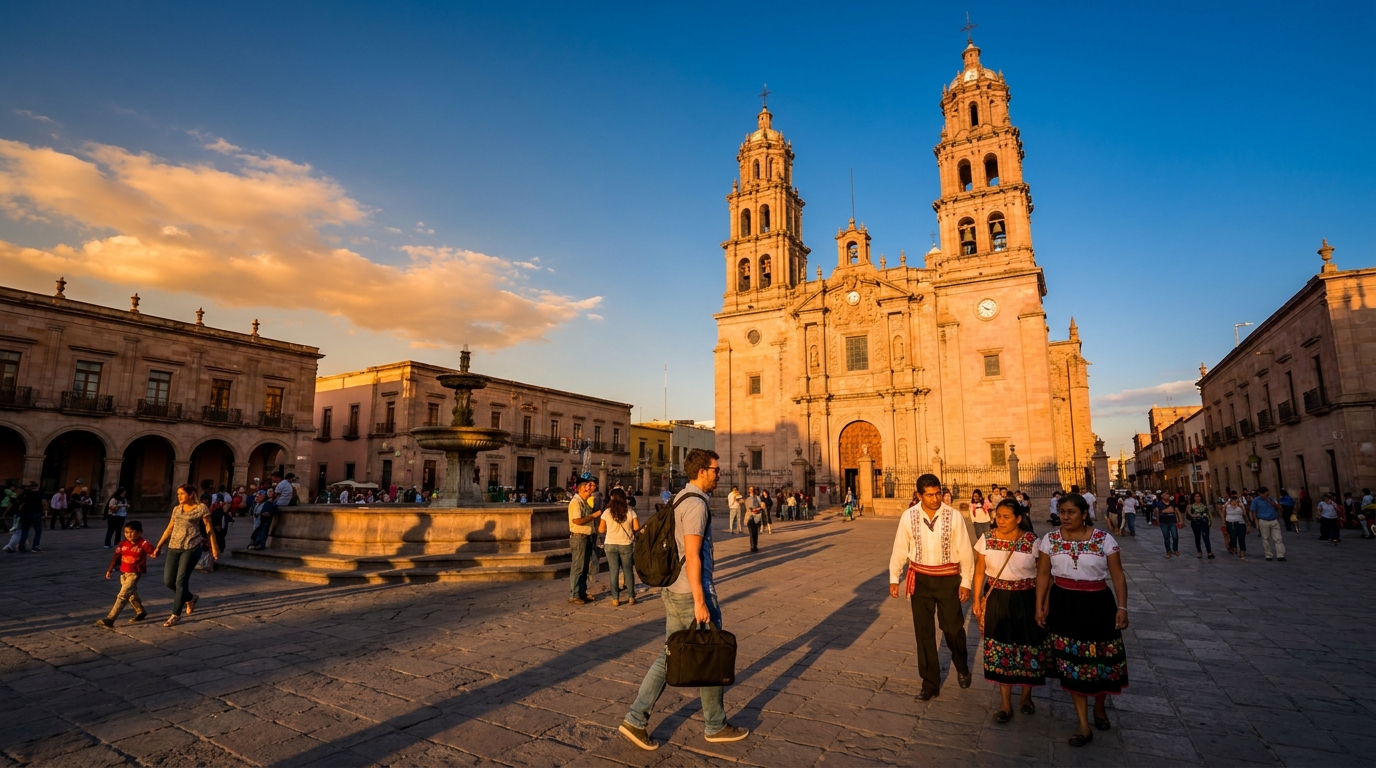
For expats, digital nomads, and slow travelers moving to Mexico's best-kept secret in the Bajío
Estimated reading time: 18 minutes · Last verified: March 17, 2026
San Luis Potosí is no longer a secret. Over the past three years, the city that locals call "SLP" has quietly become one of Mexico's most interesting destinations for people moving from abroad — whether for a year, a decade, or a long weekend. This is the 2026 update of our comprehensive living guide, rebuilt from scratch with current prices (verified in January–March 2026), the new visa rules that took effect after Mexico's 2025 UMA reform, and a new angle: this year, the guide also speaks directly to digital nomads and tourists who have started flooding into the Bajío.
If you read our 2025 version, you'll notice the numbers have shifted. Rents in the Centro Histórico rose about 15% year over year. The peso has strengthened against the US dollar (~17.5 MXN/USD in March 2026, down from ~20 in late 2024). The visa income thresholds changed in ways that matter. And SLP's coworking scene has more than doubled since we last counted — from around 25 spaces in 2024 to 51 as of early 2026, according to nomads.com's tracker.
San Luis Potosí is the capital of the state of San Luis Potosí, Mexico. Located in the central Bajío region at 1,864 meters elevation, it is a UNESCO World Heritage city (as part of the Camino Real de Tierra Adentro, 2010), home to roughly 1.31 million people in the metropolitan area. The city combines pink-cantera colonial architecture with a powerful modern industrial base — BMW, General Motors, Valeo, Continental, and over 350 international automotive-sector companies operate in the state. For foreigners arriving in 2026, SLP offers roughly 35–50% lower living costs than Mexico City for a similar quality of life, no tourist saturation, direct flights to Houston and Dallas, and a genuine Mexican urban experience.
Metro population
~1.31 million
Altitude
1,864 m / 6,115 ft
Climate
Semi-arid, ~20°C avg
MXN/USD (Mar 2026)
~17.5
Comfortable budget
$1,200–$2,000 USD/mo
Airport code
SLP (direct to USA)
Historically, content about SLP treated "expats" as a single category: Americans and Canadians retiring to Mexico. That framing is now out of date. Three distinct profiles are arriving in 2026, each with different needs, budgets, and timelines. This guide addresses all three.
Staying 1–10+ years. Priorities: residency visa, healthcare, schools, long-term rent.
Typical budget: $1,500–$3,000/mo
Staying 1–6 months. Priorities: fiber internet, coworking, cafés with Wi-Fi, monthly rentals, community.
Typical budget: $1,800–$2,500/mo
Staying 3 days to 3 weeks. Priorities: what to see, where to eat, day trips to Huasteca Potosina.
Typical budget: $60–$120/day
If you are reading this guide because you stumbled across it while researching Mexico more broadly, know this: SLP sits at the center of a triangle formed by Mexico City, Guadalajara, and Monterrey. It is the logical next step for anyone who has already visited San Miguel de Allende or Guanajuato and wants to experience colonial Mexico without the tourist surcharge. It is also the fastest-growing automotive industrial hub in the country — which matters if you are here for work rather than leisure.
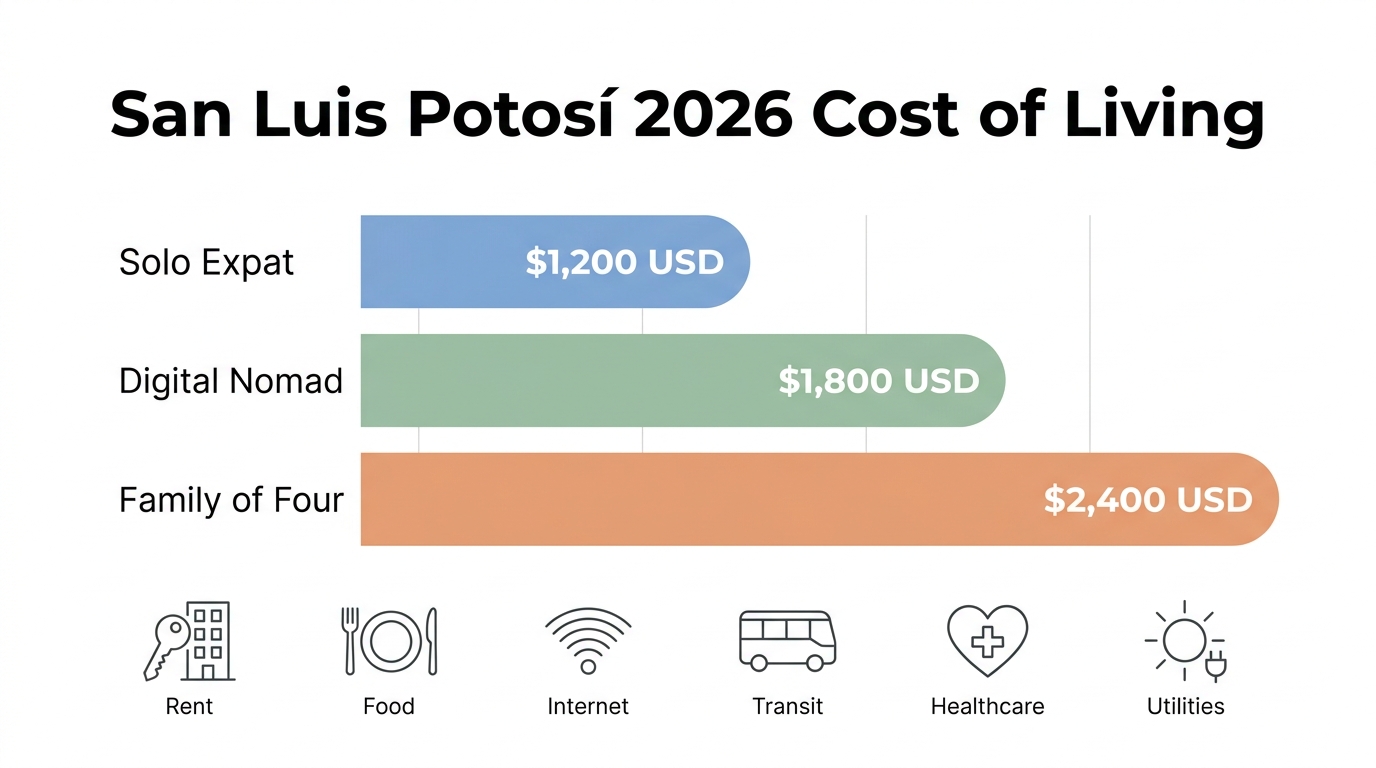
The honest answer to "how much does it cost to live in SLP" depends heavily on three factors: which neighborhood you choose, whether you want air conditioning and private parking, and how often you eat Mexican food versus international cuisine. The numbers below reflect January–March 2026 market conditions at an exchange rate of 17.5 MXN per USD.
| Expense | MXN | USD |
|---|---|---|
| 1BR apartment in city center | $11,800 | $674 |
| 1BR apartment outside center | $8,440 | $482 |
| 3BR apartment in center | $21,333 | $1,219 |
| Basic utilities (85 m²) | $797 | $46 |
| Internet (60+ Mbps fiber) | $567 | $32 |
| Monthly transit pass | $1,304 | $75 |
| Meal at inexpensive restaurant | $220 | $13 |
| Mid-range meal for two | $725 | $41 |
| Gasoline (1 liter) | $24.92 | $1.42 |
| Average net monthly salary (local) | $15,825 | $904 |
The average local salary figure is important context. Unlike Mexico City, where expat incomes are common among professionals, in SLP most residents earn in Mexican pesos from Mexican employers. This creates significant leverage for anyone earning in USD, EUR, or CAD: a $2,000 USD monthly budget puts you well above the local median.
Pay rent in pesos, not dollars
Landlords who price in USD mark up 10–15%. Negotiate pesos-only contracts. If you are a nomad paying monthly, ask for a 10% "estancia" discount for a 3-month prepayment.
Avoid Airbnb beyond 30 days
Airbnb averages 60–80% more per month than direct rentals in SLP. For stays over 4 weeks, use Inmuebles24.com or Facebook Marketplace.
CFE and water aren't negotiable — but you can shop internet
Izzi, Totalplay, and Megacable all offer 200+ Mbps fiber in Centro, Lomas, and Tangamanga for roughly $32–$50 USD/month. Telmex is legacy; skip it unless fiber isn't available on your street.
⚠️ Big change: In autumn 2025, Mexico's Congress passed a law doubling the government processing fees for residency visas and cards. The new schedule took effect November 7, 2025. Factor this into your 2026 budget.
Mexico's residency system underwent two material changes between our 2025 and 2026 guides. The first is procedural: as of July 2025, Mexican consulates were directed to calculate economic solvency using the UMA (Unidad de Medida y Actualización) rather than the daily minimum wage. This shift matters because the minimum wage has jumped 12%+ per year recently, while UMA climbs only 3–5% annually. For 2026, the UMA is 117.31 MXN per day — up 3.69% from 2025's 113.14 MXN.
The second change is financial: visa and residency card government fees roughly doubled effective November 2025. A Temporary Resident card that cost approximately 5,570 MXN in late 2024 now runs closer to 11,000 MXN for a one-year card. Budget accordingly.
| Visa type | Duration | Income / savings threshold | Best for |
|---|---|---|---|
| Tourist (FMM) | Up to 180 days | None | Short trips, nomads testing SLP |
| Temporary Resident | 1–4 years | ~$4,185 USD/month income OR ~$69,750 USD savings | Remote workers, medium-term stays |
| Permanent Resident | Indefinite | Higher thresholds; also via retirement or 4 yrs temporary | Retirees, long-term residents |
| Work Visa | 1–4 years | Tied to employer job offer | BMW, GM, Valeo, Continental transferees |
Thresholds sourced from Mexperience's 2026 residency briefing and Mexico Relocation Guide's post-UMA analysis (see Sources).
📌 Digital nomads, pay attention: Working remotely on a tourist FMM is technically a gray area under Mexican immigration law. Enforcement is minimal for foreigners earning from abroad, but if you plan to stay over 90 days, open a Mexican bank account, or sign a lease, the Temporary Resident route is much cleaner. The $4,185 USD/month threshold is achievable for most remote workers earning USD salaries.
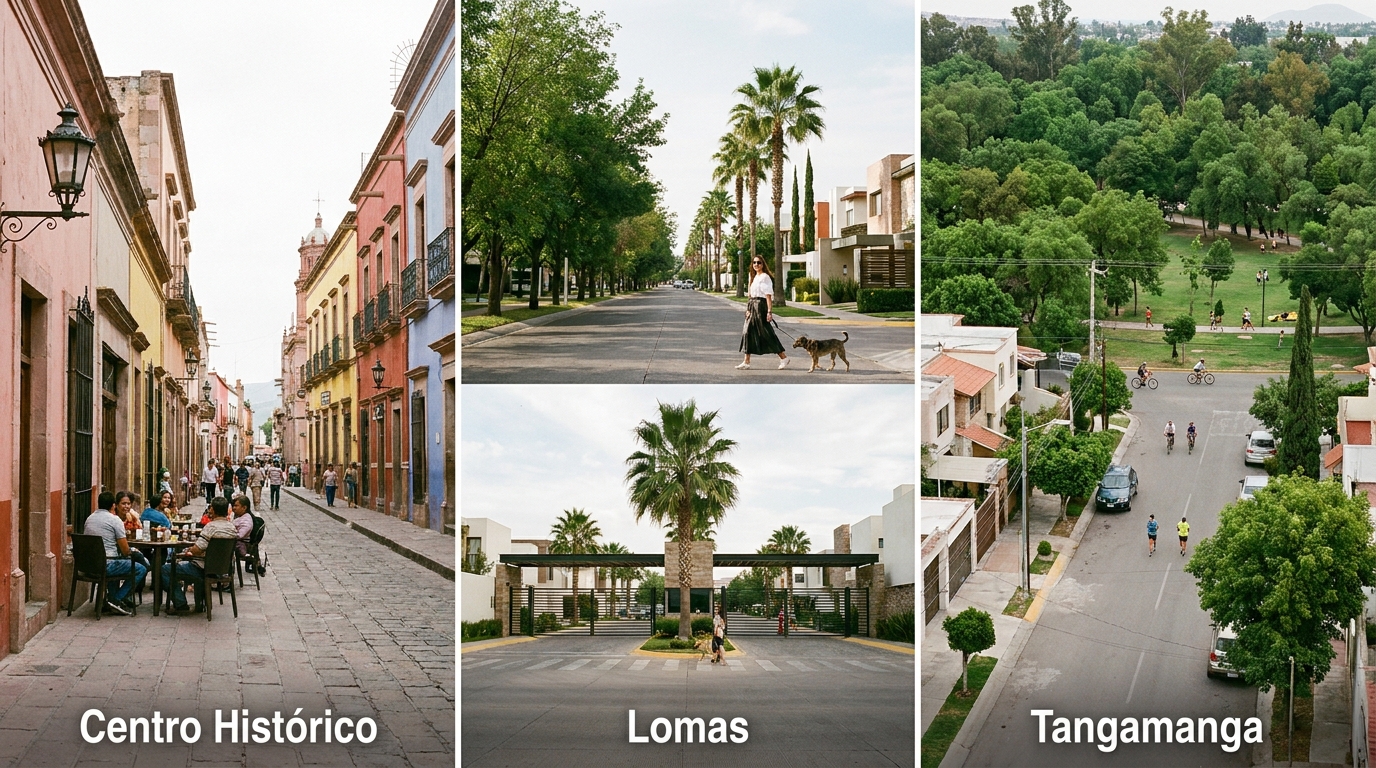
The UNESCO-designated historic center. Walkable, cobblestoned, full of cafés and restaurants. Fibre internet available everywhere. Coworking spaces like Entidad Nómada sit directly in the core. Best if you want to live without a car and soak in colonial architecture daily.
Upscale residential zone northeast of Centro. Tree-lined avenues, gated communities, international schools, malls (Plaza Citadina, Metrópoli), and the top private hospitals. Car strongly recommended. Where most BMW and GM transferees end up.
Adjacent to Parque Tangamanga I, one of the largest urban parks in Mexico (411 ha, free entry). Mid-range prices, good restaurants, popular with runners and cyclists. Fibre internet available. Rising fast as a nomad-friendly zone thanks to proximity to both the park and Centro.
Newer developments on the city's edges, popular with young professionals and remote workers. More affordable than Lomas with much of the same modern amenities. Expect newer buildings, less character, but lower prices.
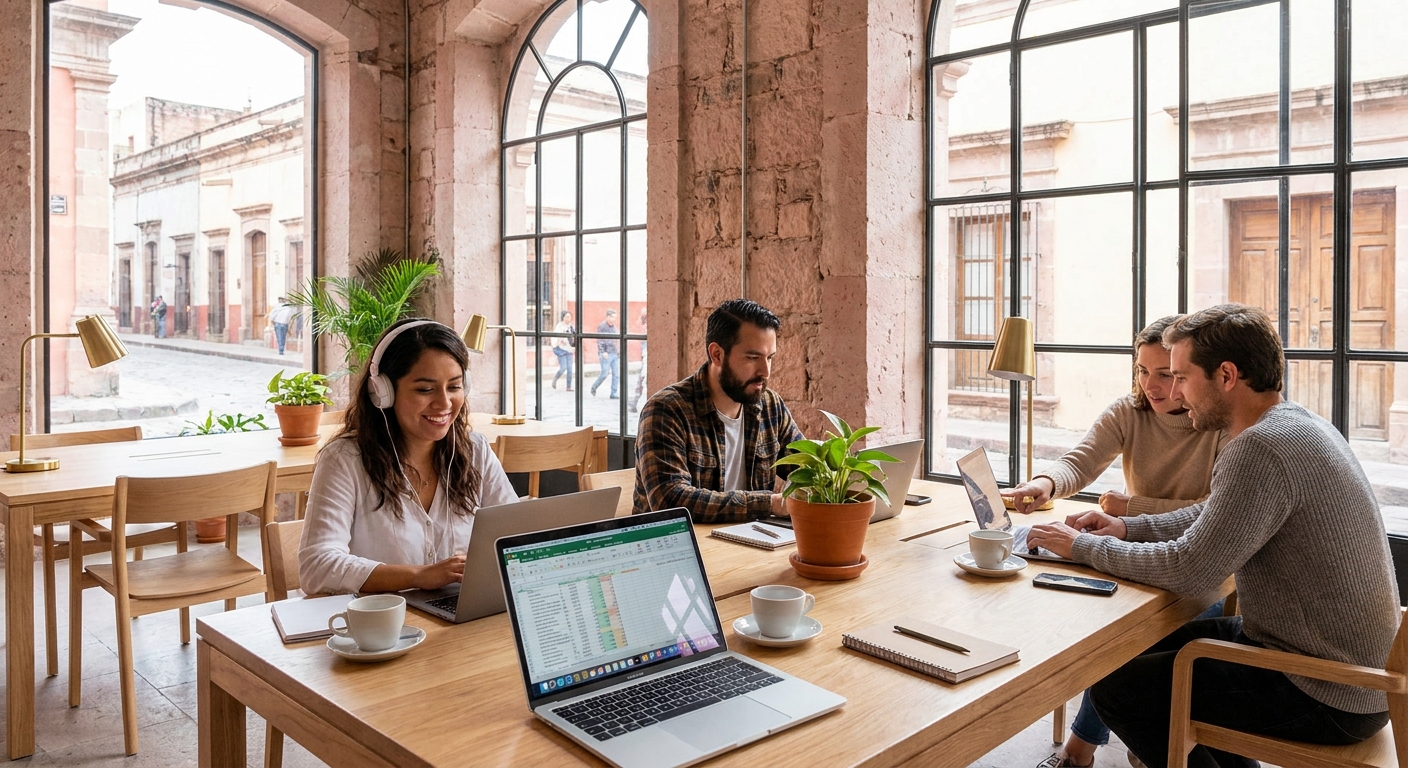
In early 2024, a digital nomad moving to SLP had about 25 coworking options. As of March 2026, nomads.com tracks 51 coworking spaces in the metro area, with day passes starting around $3 USD. The scene is younger and more informal than in Mexico City, but the basics are solid: fiber internet is everywhere, English speakers are increasingly common among staff, and the community is small enough that you'll recognize faces after a week.
Centro Histórico
Cafetería + coworking + event space. Located in a restored colonial building. Good Wi-Fi, social programming, and parking. The default recommendation if you're new.
Multiple locations
Entrepreneur-focused space with startup community. Private offices, meeting rooms, monthly membership.
Lomas area
Premium workspace aimed at executives. Good for client meetings and longer-form remote work.
Citywide
Punto del Cielo, Café Cortao, La Parroquia (branches), and the rooftop café at Centro Comercial República. All offer 50+ Mbps Wi-Fi and power outlets.
Get a Mexican SIM (Telcel or AT&T Mexico) on arrival. Unlimited data plans run about $30 USD/month. Telcel has the best coverage outside the city.
Bring a backup hotspot. Fiber is reliable, but power cuts happen during the rainy season (June–September).
Join the Facebook group "Expats en San Luis Potosí" before arriving — it is the primary informal network.
Uber and DiDi both work in the city and are the recommended transport option at night.
Plan around the rhythm: weekends many businesses close early, Monday mornings are the best time for appointments.

The state of San Luis Potosí divides into two tourism experiences: the colonial capital (this city) and the Huasteca Potosina, a subtropical region about 4–5 hours east known for waterfalls, rivers, and surrealist gardens. Most international visitors do both.
Morning: Plaza de Armas, Catedral de San Luis Potosí, Templo del Carmen (one of Mexico's most ornate baroque churches). Lunch: enchiladas potosinas at Mercado República. Afternoon: Museo Federico Silva (contemporary sculpture) or Caja del Agua (historic fountain). Evening: rooftop drinks on Calle Zaragoza.
Morning: Parque Tangamanga I — 411 hectares with a free zoo, planetarium, Japanese garden, and aquarium. Afternoon: Centro de las Artes (contemporary art center in a former penitentiary). Evening: dinner in the new gastronomic corridor along Carranza.
Three-hour drive north to Real de Catorce, a near-ghost town in the Sierra de Catorce at 2,800 m. Access is via a single-lane cobblestone tunnel. Bohemian atmosphere, silver mining history, striking desert landscapes.
Base yourself in Ciudad Valles, the regional hub 4.5 hours east of SLP city. From there, the classic circuit covers Cascada de Tamul (105 m waterfall, accessed by boat), Puente de Dios, Cascadas de Tamasopo, and the surrealist sculptures of Las Pozas de Xilitla — a garden built by British eccentric Edward James in the 1960s and now Mexico's most photographed artistic landmark outside Mexico City. Tours run $50–$120 USD per day per person including transport, guide, and meals.
📌 Tourist tip: The Huasteca is busiest during Mexican school holidays (Semana Santa — late March/early April — and mid-July through August). If you want empty rivers and full attention from guides, visit in February, October, or early November.
SLP has the strongest healthcare infrastructure of any mid-size city in central Mexico outside Querétaro. Private hospitals like Hospital Ángeles, Star Médica, and Hospital Lomas offer US-trained specialists, modern equipment, and English-speaking staff for most services. Routine private consultations run $30–$60 USD; a specialist visit runs $50–$100 USD. A private insurance policy for a couple in their 50s averages $2,400–$3,000 USD per year.
To open a Mexican bank account you need your passport, residency card (not required for Tourist FMM holders at some banks), proof of address (a recent utility bill or lease), and in some cases an RFC (tax ID). BBVA México and Santander are the most expat-friendly. HSBC offers Premier accounts with international transfer benefits. ATMs are widely available; Santander and Citibanamex have the largest ATM networks.
The US State Department classifies the state of San Luis Potosí at Level 2 — Exercise Increased Caution, the same level as France or the United Kingdom. The city itself is considered among the safer mid-size Mexican cities. Lomas, Centro, Tangamanga, and Villa Magna are the neighborhoods where foreign residents concentrate, and petty crime rather than violent crime is the primary concern. Standard precautions apply: don't flash valuables, use rideshare at night, avoid isolated areas of Zona Industrial after dark.
Potosino cuisine is distinctive enough that it has its own UNESCO-recognized traditions. The dish that tourists invariably try first is enchiladas potosinas — small red-tinted corn tortillas stuffed with cheese and served with crema and queso fresco. Beyond that, seek out asado de boda (a deep red mole traditionally served at weddings), gorditas stuffed with guisos at Mercado República, tacos de cecina, and the mezcal from the Altiplano Potosino region.
The restaurant scene in 2026 has three clear tiers: traditional family-run fondas ($3–$7 USD meals), contemporary Mexican restaurants along Calle Carranza ($15–$30), and a growing cohort of international and fusion concepts in Centro and Lomas ($25–$60). International cuisine options have expanded significantly since 2024 — there are now solid ramen, Korean BBQ, Peruvian, and Middle Eastern options, though the city still doesn't match the depth of Mexico City or Guadalajara.
SLP's foreign community is small (estimates range from 2,000 to 5,000 full-time foreign residents, though no official number exists) and blended. Unlike San Miguel de Allende, there is no English-language newspaper, no English-speaking religious services dominant in the city, and no cluster of expat-only bars. This is both a downside (harder to land a ready-made social circle) and an upside (Spanish improves fast by necessity).
The three largest subgroups are: industrial professionals (German BMW engineers, Japanese Toyota suppliers, Korean Kia-adjacent staff), retirees (primarily American and Canadian), and a rapidly growing digital nomad cohort (mostly US, European, and Latin American remote workers). Social life clusters around Facebook groups, meetups at Entidad Nómada and similar coworking spaces, and language-exchange nights at specific cafés.
A comfortable middle-class lifestyle costs $1,200–$2,000 USD per month for a single person, $1,800–$2,500 for a couple, and $2,400–$3,500 for a family of four. A digital nomad with a dedicated coworking membership typically budgets $1,800 USD/month. Numbers verified against Numbeo (January 2026 update) and local listings.
The US State Department rates San Luis Potosí at Level 2 — Exercise Increased Caution, the same level as France. The city itself is among the safer mid-size Mexican cities. Petty crime (pickpocketing in tourist areas, occasional car break-ins in industrial neighborhoods) is the main concern. Violent crime is rare in the neighborhoods where foreign residents concentrate.
Only with significant friction. Unlike San Miguel de Allende, SLP has limited English-speaking infrastructure. Most doctors, landlords, and government services operate in Spanish. Basic Spanish (A2 level) is realistic after six months of immersion. CELE at UASLP offers structured classes; private tutors run $10–$15 USD per hour.
For stays under 180 days, the Tourist FMM is free and automatic. For longer stays, the Temporary Resident visa (1–4 years) is the standard route. As of 2026, you need to demonstrate either ~$4,185 USD/month income for 6–12 months, or ~$69,750 USD in savings over the past 12 months. Government fees roughly doubled in November 2025.
Very reliable in the city. Fiber internet at 100–500 Mbps is available across Centro, Lomas, Tangamanga, and most middle-class neighborhoods through Izzi, Totalplay, and Megacable. Monthly costs run $32–$50 USD for 200+ Mbps. The rainy season (June–September) brings occasional power cuts; a mobile hotspot as backup is recommended.
Ponciano Arriaga International Airport (SLP) has direct flights from Houston (United), Dallas (American, Volaris), and Mexico City (Aeroméxico, Volaris). Alternatively, Querétaro (QRO) and León (BJX) are each 2.5–3 hours by car or first-class bus (ETN, Primera Plus). From Mexico City, first-class bus is 5 hours and runs about $40 USD.
October–March for dry, mild weather (daytime 20–25°C, cool evenings). Semana Santa (Holy Week, late March/April) for the Procesión del Silencio. Late June for the BMW Maratón Tangamanga. Avoid mid-July through August if you want to escape crowds at FENAPO and school holidays.
No. Use garrafones (20-liter purified water jugs) delivered to your home for roughly 35–50 MXN (~$2–$3 USD). All mid-range restaurants use purified ice and water; cheaper fondas are safe but stick to bottled beverages to be cautious.
All figures in this guide verified against primary sources as of March 17, 2026.
Explore our companion guides for specific scenarios:
Gear and home items our community recommends for life and adventure in SLP.
Clean drinking water at home — a must-have setup item for expats arriving in Mexico.
$400–800 MXN
View on Mercado LibreAffiliate link
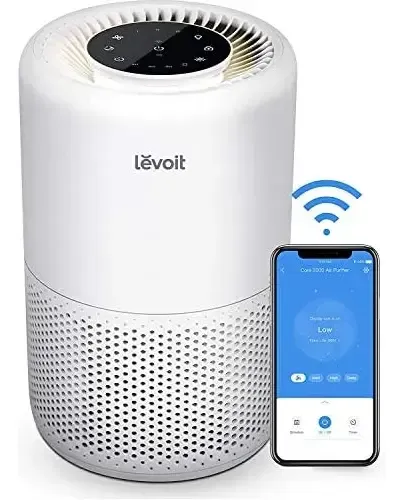
SLP is dry and dusty. A HEPA purifier helps expats avoid respiratory issues in the first months.
$1,500–3,500 MXN
View on Mercado LibreAffiliate link
Get practical tips to navigate the city, weekly events, and useful local info delivered to your inbox.
Join our community. No spam, ever.
Free events, new restaurants, updated guides — every week.
Get weekly updates on new places, events, and expat tips delivered to your inbox.
We respect your privacy. Unsubscribe at any time.


